Introduction
Usage-based pricing is no longer reserved for cloud providers. API companies, AI tools, developer platforms, storage products, and infrastructure SaaS apps increasingly charge by events, seats plus overages, credits, tokens, messages, storage-GB, requests, or compute minutes. For a Node.js SaaS team, that sounds manageable — until the first customer asks why an invoice differs from the usage screen, why a late event changed the bill, or whether a contract can include prepaid credits, committed spend, tiered rates, and a custom enterprise discount in a single deal.
This guide compares the most practical usage-based billing and metering options for Node.js SaaS apps in 2026: Stripe Billing Meters, Metronome, Orb, Lago, and OpenMeter / Kong Metering & Billing. It focuses on production architecture, not just pricing-page copy.
What Usage-Based Billing Actually Requires in Production
A production metered billing system has far more moving parts than “count events and charge money.” At minimum, you need to answer these questions:
- What is the billable event? Is it an API call, a token consumed, a storage byte, or a seat-day?
- Can the event be safely retried without double-charging? Idempotency is non-negotiable.
- Which customer, workspace, project, API key, or organization owns the event? Tenancy boundaries must be explicit.
- Is the event used for billing, entitlement limits, analytics, or all three? Different consumers need different aggregation windows.
- Can late-arriving usage be corrected before invoice finalization? Backfills and corrections are inevitable.
- Can customers see usage before the bill arrives? Usage transparency reduces disputes.
- Can finance reconcile invoices against raw usage and contracts? Revenue recognition demands an audit trail.
- Can sales create negotiated pricing without engineering changes? If every enterprise deal requires a code deploy, you have a problem.
A small Node.js app might start with a few counters in PostgreSQL and Stripe subscriptions. That works for a simple “10,000 requests included, then $X per 1,000 requests” model. But once you add credits, usage dashboards, enterprise contracts, multiple pricing dimensions, AI token costs, or customer-specific pricing, a dedicated metering or billing layer becomes far more attractive.
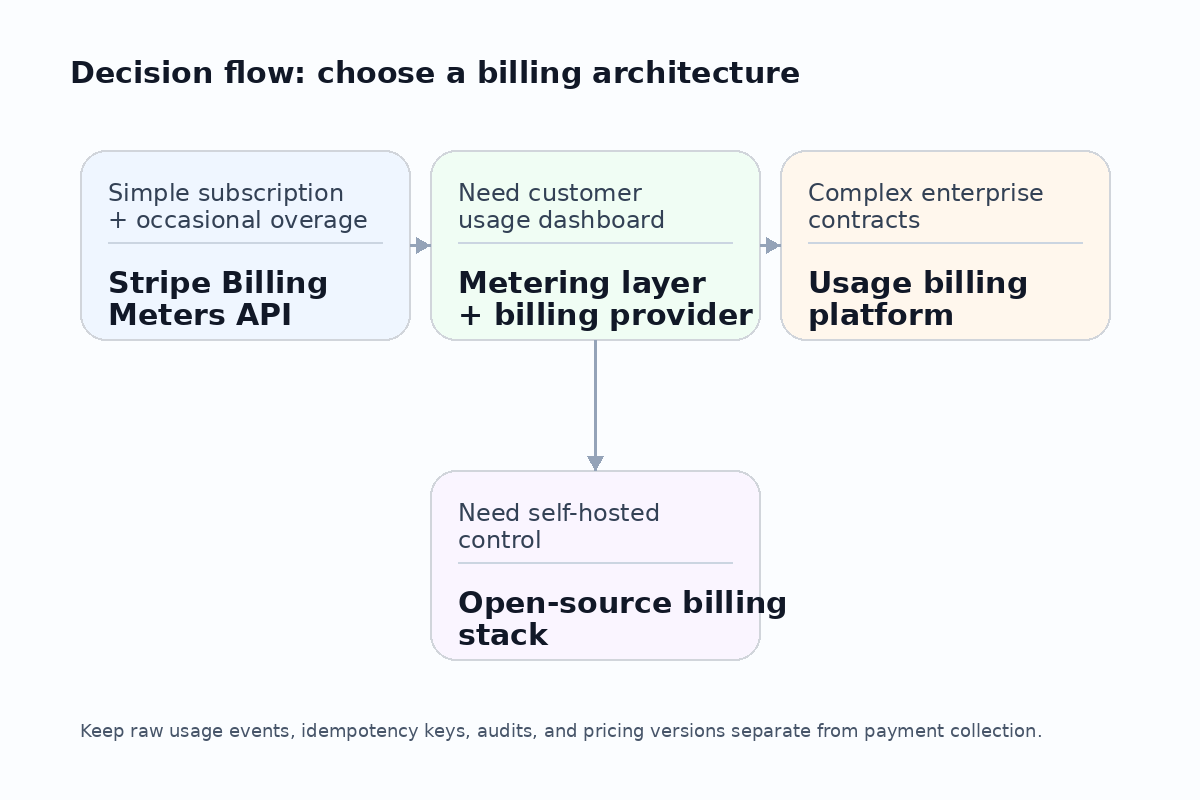
The safest architecture separates four concerns:
- Event ingestion from the Node.js application.
- Metering and aggregation of raw usage into billable quantities.
- Pricing and rating — applying the right price to the right metric for the right customer.
- Payment collection, invoicing, tax, and revenue operations — the financial plumbing.
Keep those concerns separate and your app won’t accidentally become a finance system.
Quick Comparison Table
| Platform | Best Fit | Strengths | Watch Out For | Pricing Note |
|---|---|---|---|---|
| Stripe Billing Meters | Simple SaaS subscriptions with metered components | Native Stripe integration, familiar payment stack, straightforward subscriptions | Complex contracts, deep usage dashboards, and advanced rating may require extra infrastructure | Pay-as-you-go Billing volume pricing; confirm before publishing |
| Metronome | High-scale usage billing for AI, API, and infrastructure companies | Raw event handling, SQL-style metrics, enterprise revenue workflows, Stripe ecosystem alignment | Enterprise buying process; pricing is rarely a simple self-serve calculator | Confirm before publishing |
| Orb | Mission-critical usage-based billing and revenue operations | Real-time event ingestion, custom SQL metrics, alerts, invoicing, finance integrations | Custom pricing; may exceed early-stage needs | Confirm before publishing |
| Lago | Open-source or cloud billing for flexible SaaS pricing | Self-hosting, API-first, payment-agnostic, hybrid pricing models | Self-hosting operational burden; review AGPL license implications | Cloud pricing should be confirmed before publishing |
| OpenMeter / Kong Metering & Billing | Real-time metering, entitlements, usage limits, and Stripe-connected usage sync | CloudEvents-style ingestion, meters, usage limits, open-source foundation | Product packaging changed as OpenMeter became Kong Metering & Billing | Confirm current cloud details before publishing |
1. Stripe Billing Meters
Stripe is usually the first place Node.js SaaS teams look because payment collection, subscriptions, Checkout, customer portal, invoices, tax, and webhooks may already be in the stack. Stripe’s Meter Events API lets you emit usage events that Billing Meters aggregate over a billing period and attach to prices.
For a simple Node.js SaaS app, this can be enough:
- A customer subscribes to a plan.
- Your API emits a usage event when the customer consumes a billable unit.
- Stripe aggregates usage for the billing period.
- Stripe generates the invoice.
That is attractive because you don’t need to run a separate billing engine. You can also reuse Stripe webhooks for subscription lifecycle, payment failures, invoice finalization, and customer portal flows.
Sample: Emitting a Stripe Meter Event from Node.js
import Stripe from "stripe";

const stripe = new Stripe(process.env.STRIPE_SECRET_KEY!);

async function recordApiCall(customerId: string, count: number) {
  await stripe.billing.meterEvents.create({
    event_name: "api_calls",
    payload: {
      stripe_customer_id: customerId,
      value: count.toString(),
    },
    timestamp: Math.floor(Date.now() / 1000),
    identifier: `${customerId}-${Date.now()}-${crypto.randomUUID()}`,
  });
}
When Stripe Billing Meters Are a Good Fit
Use Stripe Billing Meters when your model is relatively clear:
- One or a few usage metrics.
- Simple aggregation rules.
- Limited contract customization.
- A Stripe-first payment and invoice flow.
- A team that wants fewer vendors and fewer moving parts.
Examples include “messages sent,” “active projects,” “API calls,” “documents processed,” or “storage GB-months” where the rating model is easy for customers to understand.
Where Stripe Alone Can Become Difficult
Stripe is not always the best place to build your entire usage data model. If your customer dashboard needs real-time usage, if you need to replay events, if sales wants negotiated contracts, or if finance needs detailed usage reconciliation, you may still need your own usage warehouse or metering layer.
A practical Node.js approach is to send events to your own durable pipeline first, then forward billable usage to Stripe. That way Stripe remains the billing and payment system, while your own infrastructure keeps the audit trail.
2. Metronome
Metronome is now presented by Stripe as a usage-based billing platform for AI and modern software companies. It emphasizes raw usage event storage, SQL-based metrics, low-latency streaming events, and scale. Stripe’s documentation describes a split where Metronome handles usage-based billing, credit-based pricing, enterprise contracts, and multi-dimensional rating, while Stripe handles payment collection, tax, revenue recognition, data export, and fraud screening.
That separation is exactly what many serious SaaS teams eventually need.
When Metronome Is a Good Fit
Metronome makes sense when billing is a product-critical system rather than a small add-on:
- AI products charging by tokens, credits, tasks, or model cost.
- API businesses with high event volume.
- Infrastructure SaaS with multi-dimensional pricing.
- Enterprise contracts with commits, credits, discounts, and marketplace channels.
- Teams that want usage billing to integrate with revenue operations.
For a Node.js team, the key architecture decision is whether your app should push raw events directly to Metronome, stream them through a queue first, or use a warehouse/streaming pipeline as the system of record.
Cost and Buying Considerations
Metronome is not evaluated like a $20/month developer tool. It is closer to revenue infrastructure. If your billing complexity is small, it may be too much. If billing mistakes can cost real money or block enterprise deals, it may be exactly the kind of specialized system you want. Pricing and contract details should be confirmed before publishing because public enterprise pricing may change and depends on usage, revenue, event volume, support, and implementation scope.
3. Orb
Orb positions itself around mission-critical usage-based billing and revenue design. Its feature set includes real-time event ingestion, real-time alerting, hybrid and usage-based billing, automated price changes, invoicing, finance and tax integrations, and custom pricing. It also highlights custom SQL metrics, threshold billing, data warehouse sync, customer hierarchy, and integrations with Salesforce, NetSuite, accounting tools, and tax providers.
When Orb Is a Good Fit
Orb is especially relevant if:
- You expect pricing to change often.
- You need sales-led and self-serve plans in the same product.
- You sell to enterprise customers with custom terms.
- You need real-time customer alerts for usage or cost thresholds.
- Finance wants clean invoice, accounting, and warehouse workflows.
- You need to model usage from raw events rather than only pre-aggregated counters.
A developer tooling company, AI workflow platform, API platform, or infrastructure SaaS product could use Orb to avoid building a large internal revenue platform.
What to Evaluate Carefully
Orb’s public pricing uses custom pricing. That is not automatically bad — it may align cost with billings and event volume. But early-stage teams should confirm minimum platform costs, implementation effort, support level, and data portability before committing. Map your event schema before evaluating any vendor. A billing platform can ingest events, but it cannot magically fix ambiguous product metrics.
4. Lago
Lago is a strong option for teams that want open-source billing infrastructure or more deployment control. Its GitHub repository describes Lago as an open-source billing platform for usage-based, subscription-based, and hybrid pricing models. It offers an API-first approach, payment-agnostic integrations, self-hosting, usage metering, billing and invoicing, entitlements, payment orchestration, revenue analytics, and a Node.js SDK.
When Lago Is a Good Fit
Consider Lago when:
- You need self-hosting or strict data control.
- You want to avoid hard dependency on a single payment processor.
- You need hybrid plans that combine seats, subscriptions, usage, and custom pricing.
- You want an API-first billing system with open-source visibility.
- You have enough engineering capacity to operate or deeply customize the system.
Lago fits Node.js SaaS teams that serve regulated customers, operate in regions where payment providers vary, or need pricing models difficult to express in a basic subscription tool.
Open-Source Tradeoffs
Open source does not mean zero cost. You may pay in hosting, upgrades, monitoring, operational support, and internal expertise. Review the license and commercial terms carefully before embedding or modifying the platform in a commercial environment. For teams that want control, those tradeoffs may be worth it. For a tiny SaaS app that just needs one metered price, managed Stripe Billing may be simpler.
// Example: Creating a billable metric via Lago's Node.js SDK
import { LagoClient } from "lago-javascript-client";

const lago = new LagoClient({ apiKey: process.env.LAGO_API_KEY! });

await lago.billableMetrics.createBillableMetric({
  billableMetric: {
    name: "api_calls",
    code: "api_calls",
    aggregation_type: "sum_agg",
    field_name: "count",
    description: "Number of API requests per customer per billing period",
  },
});
5. OpenMeter / Kong Metering & Billing
OpenMeter focuses on real-time metering for AI, API, and infrastructure usage. Its pricing page now states that OpenMeter Cloud is Kong Metering & Billing, with the same team and product direction. The platform describes real-time scalable metering for AI and API usage, governance of AI and API access and cost, and a no-code product catalog for pricing iterations.
The OpenMeter GitHub repository describes usage metering through CloudEvents-style ingestion, flexible aggregations (SUM, COUNT, AVG, MIN, MAX), real-time usage queries, usage-based billing, and usage limits or entitlements.
When OpenMeter Is a Good Fit
OpenMeter or Kong Metering & Billing is worth evaluating when the metering layer is the hardest part of your system:
- API limits and entitlements.
- AI token or cost governance.
- Real-time usage dashboards.
- Usage sync into billing systems.
- Infrastructure-style consumption metrics.
- A desire to keep metering conceptually separate from payment collection.
For a Node.js API product, this can pair well with a gateway, API key system, queue, and Stripe or another payment provider.
What to Verify Before Choosing
Because the cloud product packaging has changed, confirm current pricing, feature availability, Kong integration details, and support terms before publishing or buying. Also check whether you want the metering system to own billing, sync to Stripe, or only provide usage limits and analytics.
// Example: Sending a CloudEvents-style meter event to OpenMeter
async function recordMeterEvent(
  subject: string,
  meterSlug: string,
  value: number
) {
  await fetch("https://api.openmeter.cloud/api/v1/events", {
    method: "POST",
    headers: {
      "Content-Type": "application/cloudevents+json",
      Authorization: `Bearer ${process.env.OPENMETER_API_KEY}`,
    },
    body: JSON.stringify({
      specversion: "1.0",
      type: meterSlug,
      source: "my-nodejs-api",
      subject,
      id: crypto.randomUUID(),
      time: new Date().toISOString(),
      data: { value },
    }),
  });
}
Recommended Node.js Architecture
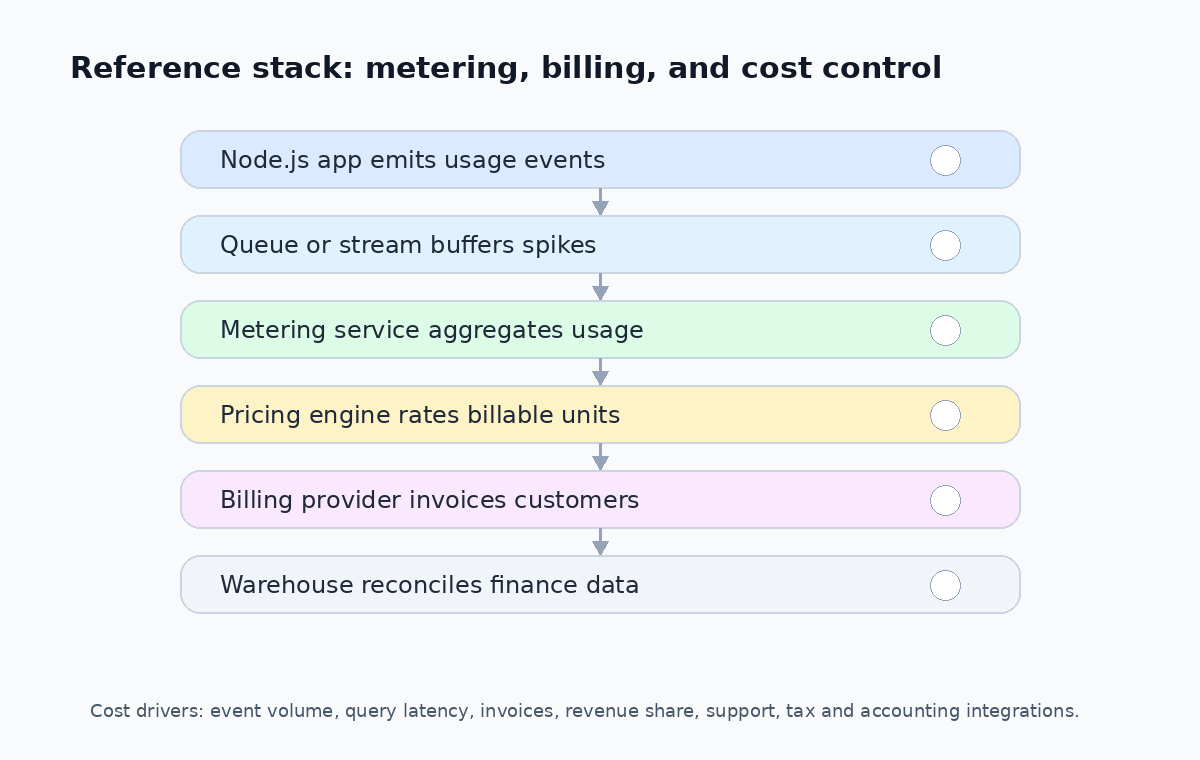
A robust Node.js metering architecture should not emit invoice-changing data from random controller code without a durable path. A practical setup looks like this:
- The Node.js app records usage events with a stable event ID.
- Events are written to a queue, stream, or durable outbox table.
- A worker validates and enriches events with customer, workspace, plan, API key, and timestamp data.
- Raw events are stored for audit and replay.
- A metering layer aggregates usage into billable metrics.
- A billing system rates usage according to the active pricing version.
- Invoices are generated by the billing provider.
- A warehouse or finance export reconciles events, invoices, payments, and revenue.
This architecture may sound heavy, but you can adopt it gradually:
- Day 1: Outbox table + idempotent event IDs.
- Growth phase: Add a queue when traffic increases.
- Complexity phase: Add a dedicated metering platform when pricing or customer visibility becomes complex.
TypeScript: Durable Outbox Pattern for Usage Events
import { PrismaClient } from "@prisma/client";
import { randomUUID } from "node:crypto";

const prisma = new PrismaClient();

interface UsageEvent {
  customerId: string;
  workspaceId: string;
  eventName: string;
  quantity: number;
  unit: string;
  occurredAt: Date;
  metadata: Record<string, string>;
}

async function enqueueUsageEvent(event: UsageEvent): Promise<string> {
  const eventId = randomUUID();

  await prisma.usageEventOutbox.create({
    data: {
      id: eventId,
      customerId: event.customerId,
      workspaceId: event.workspaceId,
      eventName: event.eventName,
      quantity: event.quantity,
      unit: event.unit,
      occurredAt: event.occurredAt,
      receivedAt: new Date(),
      metadata: event.metadata,
      schemaVersion: 1,
      status: "pending",
    },
  });

  return eventId; // Return for idempotency tracking
}
Event Design Checklist for Node.js Teams
Before picking a vendor, design the event model. A strong event should include:
| Field | Purpose |
|---|---|
event_id | Globally unique for idempotency |
customer_id | Billing customer |
workspace_id / organization_id | Tenant boundary |
subject_id | API key, user, project, model, region, or feature |
event_name | Stable metric name (never change semantics) |
quantity | Numeric usage value |
unit | request, token, GB, minute, message, job, export, seat |
occurred_at | When usage actually happened |
received_at | When your system received it |
metadata | Controlled fields needed for pricing dimensions |
schema_version | So future changes don’t break old events |
Never rely only on invoice totals as your source of truth. If a customer disputes a bill, you need the raw usage path — every event, with timestamps and provenance.
Cost Factors to Compare
Usage-based billing platforms charge in different ways. Some are transparent; others require a sales conversation. Compare total cost across these dimensions:
- Monthly platform fee
- Percentage of billings or revenue
- Event ingestion volume
- Stored events or retention period
- Invoice volume
- Number of customers or subscriptions
- Usage dashboard features
- Data warehouse sync
- Salesforce, NetSuite, tax, or accounting integrations
- Support tier and SLA
- Implementation or migration services
- Self-hosting operational costs
Also consider the cost of mistakes. A cheaper platform is not cheaper if it causes underbilling, customer disputes, manual finance work, or months of engineering time.
Recommendations by Use Case
Early-Stage SaaS with One Usage Metric
Start with Stripe Billing Meters and your own raw usage log. Keep the architecture simple, but do not skip idempotency or audit storage. This is the best first step because you can ship pricing without running a large revenue platform.
API or AI Product with Fast-Changing Pricing
Evaluate a dedicated metering layer or full usage billing platform. OpenMeter / Kong can be a strong metering-first option. Orb and Metronome are stronger when pricing, invoicing, and revenue operations become complex.
Enterprise Contracts Drive Your Revenue
Look closely at Orb or Metronome. Enterprise billing often needs commits, credits, amendments, mid-cycle changes, custom pricing, customer hierarchies, and finance integrations. Those requirements are painful to bolt onto a basic subscription system later.
Self-Hosting or Payment-Provider Flexibility Required
Evaluate Lago. It is especially interesting if you need open-source visibility, payment-agnostic billing, or deeper control over deployment and customization.
Usage Limits Matter as Much as Invoices
Choose a metering system that supports entitlements and limits, not just invoices. For API SaaS, usage limits are part of the product experience. Customers need to know when they are near a quota before they receive an invoice.
Common Implementation Mistakes
Mistake 1: Treating Billing as Analytics
Analytics can be approximate. Billing cannot. You need idempotency, audit trails, timestamps, correction workflows, and clear ownership of every event.
Mistake 2: Hardcoding Pricing into Node.js Business Logic
Hardcoded pricing slows down sales and product experiments. Put pricing rules in a billing or pricing system where versions can be tracked.
Mistake 3: Only Storing Aggregated Counters
Aggregates are useful, but raw events are what you need for backfills, disputes, migrations, and debugging. Store both.
Mistake 4: Forgetting Customer-Facing Usage Visibility
If customers are charged by usage, they should be able to see usage. A good billing architecture supports near-real-time dashboards, alerts, and exportable usage history.
Mistake 5: Ignoring Finance and Tax Workflows
Billing touches accounting, tax, revenue recognition, sales contracts, refunds, credits, and support. Engineering-only decisions can create finance problems later. Involve your finance team early.
Conclusion
The best usage-based billing platform for a Node.js SaaS app depends less on your framework and more on your pricing complexity:
- Simple pricing? Start with Stripe Billing Meters and a durable raw usage log.
- Metering and entitlements are the hard part? Evaluate OpenMeter / Kong Metering & Billing.
- Billing is a strategic revenue system? Compare Orb and Metronome.
- Self-hosting and payment-provider flexibility matter? Lago deserves a serious look.
The main rule is simple: do not let a few counters in your Node.js app become your entire billing system. Preserve raw events, use idempotency, version your pricing, and keep payment collection separate from metering when your business model starts to evolve.